When Shopping Becomes the Only Warmth. A Somatic Therapy Approach to Compulsive Behavior

This story is a composite drawn from real therapeutic themes and shared for educational purposes. No identifying information.
She made a three-course meal for her husband that night.
Candles lit. Table set. Conversation flowing.
And a $6,000 shopping bill hidden in her purse.
She wasn't hiding purchases. She was hiding the ache underneath them.
—-
From the first time I met Sarah*, I noticed something about her. She carried a particular quality of heaviness that exists when we’ve been carrying something for too long.
Last Monday, she came in, lowered herself into the chair across from me and exhaled.
"I did it again," she said, turning her phone toward me.
Fourteen confirmation emails. Timestamps between 10pm and midnight.
I didn't say anything. I just looked at her. She already knew what I was going to ask.
"Tell me about last night."

The Three Course Meal and the $6,000 secret
The evening before, she had spent two hours making a delicious dinner for her husband.
Three courses. Candles. The good plates.
The kind of evening that says something without saying it, “ I want to be close to you tonight. I want us to be warm together. I am trying.”
They ate. They talked. It was good.
And then somewhere between the dishes and him falling asleep, something shifted.
A look crossed his face. Not unkind. Just, elsewhere. That particular quality of someone going somewhere inside themselves that you cannot follow. When they are thinking about work, their day, or just processing something on their own.
He didn't do anything wrong. He just disconnected for a bit.
But Sarah*, being hyper-attentive felt the shift.
A feeling of hollowness arrived in her chest.
Then, her throat tightened, and her hands became restless….. feeling the need to reach for something, anything, before the feeling of disconnect settled in completely.
She kissed him goodnight. They made love, and as far as he knew, all was well.
But, what he didn’t yet know was that as she lay beside him in the dark, the restless feeling continued.
Instead of falling into a deep slumber, she did what she knew how to do to sooth herself….
She reached for her phone.
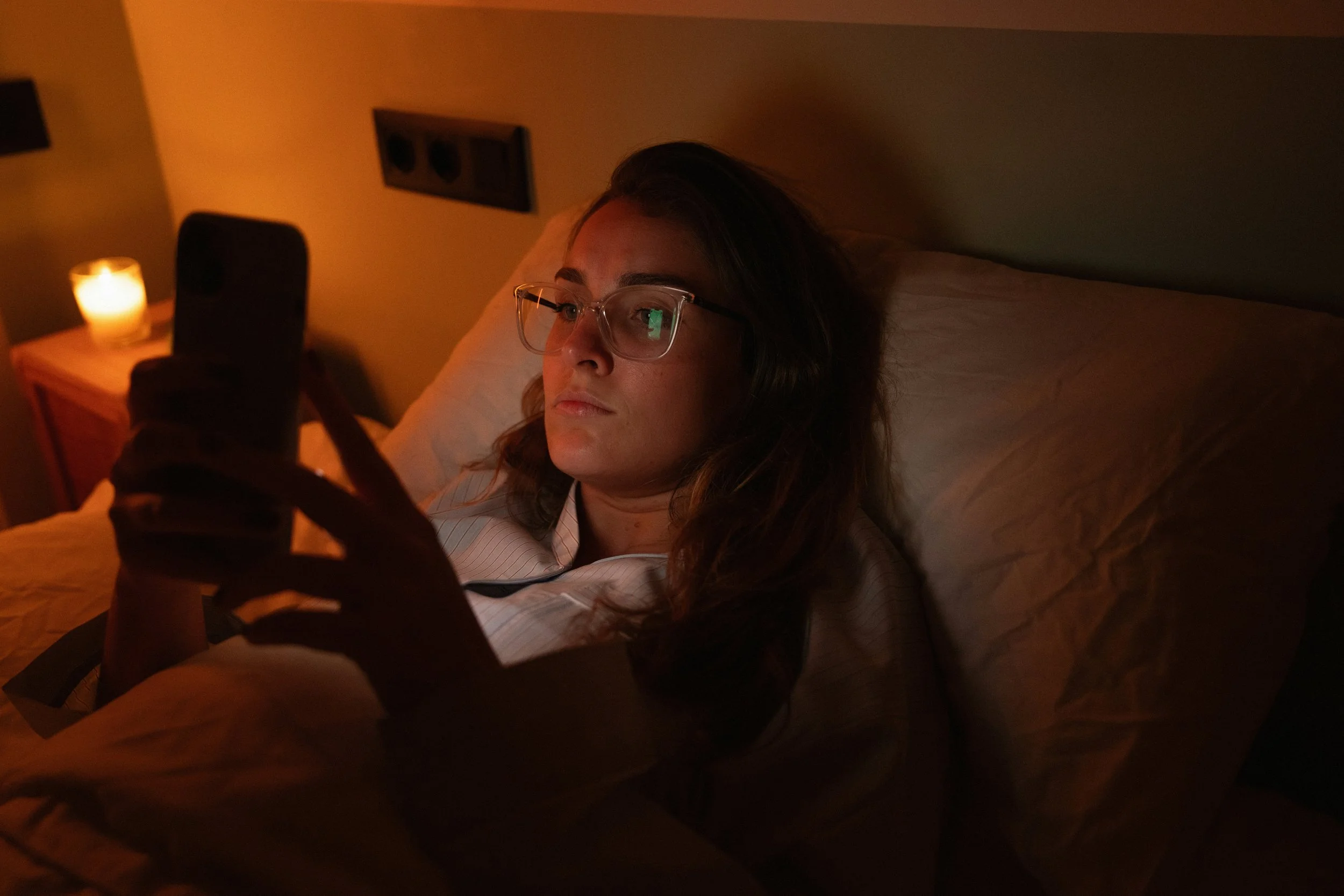
Scrolled,
And then clicked. And clicked. And clicked.
By midnight there was $6,000 worth of “things” ….
…making their way to her doorstep from fourteen different directions.
Dresses she didn't need.
Candles she already had.
Three versions of the same throw blanket in different colors.
She didn't truly want any of it. She never did.
When the packages would arrive, she'd try half of them on. The other half would sit in bags by the door for weeks, unopened, like evidence of something she couldn't quite name.
"I just needed to make the hollow feeling go away," she said.
And that, right there, was everything.
What the Click Actually Does: Understanding Compulsion Through a Somatic Lens

Here is what I want you to understand about what happened in Sarah's body the moment she pressed purchase.
It wasn't about the things.
The instant she clicked, before the confirmation screen even loaded, before she knew what she was buying, her brain released dopamine.
The neurotransmitter of anticipation. Of something is coming.
A feeling of connection.
For thirty seconds, maybe sixty, she felt it. Warmth.
The cushioned, cloud-soft feeling of being held by something. Like sinking into pillows.
Like being a small child who has been scooped up and wrapped in something warm. Something is on its way to you. You matter enough to receive.

That feeling is not nothing.
For a nervous system that has spent years not knowing when the warmth is coming or when it will withdraw, that feeling is everything.
And here is what made it so seductive, so reliable, so impossible to stop:
She could produce it herself.
She didn't have to wait for her husband to look at her the right way. She didn't have to perform something charming or ask the right question or read the room correctly. She just had to click. And the warmth arrived. Instant. Predictable. Hers.
The problem was it only lasted a fleeting sixty seconds.
And then the empty came back.
Bigger than before.

I want to be careful here because it would be easy to read this as a story about a marriage.
It isn't.
The trigger that night was her husband going somewhere she couldn't follow. But that trigger had a thousand other faces.
The friend who went quiet mid-conversation, that particular quality of someone becoming politely distant, and Sarah would feel the drop and spend the rest of the evening clicking through her phone, adding things to carts she never checked out.
The Sunday afternoon silence. The particular emptiness of an unstructured day when there was no one reaching for her, no warmth being directed her way, and her chest would fill with that hollow stone and her hands would start to reach.
The work meeting that ended without anyone saying her name. The text she sent that didn't come back. The moment in a group conversation when the energy shifted and she was no longer the one everyone was talking to.
Any withdrawal of warmth. From any direction.
The click to purchase was always waiting on the other side of it.

This is the pattern I see underneath compulsive shopping, compulsive eating, compulsive scrolling, compulsive anything.
Not one trigger. A nervous system organized around the terror of warmth withdrawing.
And a body that has found its most reliable, most available, most controllable source of relief.
What Her Body Had Learned Long Before Him
A few sessions later, the real story arrived.
Not through a question I asked. Sideways, the way the important things always come.
We were talking about something else entirely when she mentioned her mother.
Her mother had not been warm.
She had been critical. Dismissive. The kind of mother who looked at her daughter's softness and saw something to fix. Who met vulnerability with irritation. Who made Sarah feel, without ever saying it directly, that her needs were a burden. That her presence was too much. That wanting closeness was a flaw she needed to outgrow.
Sarah learned early: Don't need too much. Don't ask for too much. Don't take up too much space.
And underneath that: If I'm not perfect, if I'm not easy, if I'm not performing. the warmth disappears.
But here's what made it devastating.
The warmth wasn't consistent to begin with. Her mother could be cold for days, weeks, and then suddenly soften.
A moment of tenderness. A flicker of approval. Just enough to make Sarah believe that if she got it right, if she figured out the formula, the warmth would stay.
It never did.
So Sarah's nervous system learned something very specific: Distance is danger.
Not because distance is inherently harmful, in adult relationships, space is normal, healthy, necessary.
But for Sarah's system, any distance felt like the beginning of withdrawal. Like salt being poured into an open wound.
Her nervous system couldn't distinguish between healthy space and emotional abandonment.
It had never learned the difference. Because in her childhood, there was no difference. Distance always meant disapproval. Silence always meant she had failed.
This is why compulsive behaviors are so hard to interrupt with insight alone.
Sarah wasn't shopping because she didn't understand her patterns. She understood them perfectly.
She was shopping because her body was running a program that had been installed decades ago, before language, before logic, before she had any say in the matter.

The program said: When warmth withdraws, you are in danger. Find warmth immediately. Manufacture it if you have to. Do not sit in the drop.
And the click, the dopamine hit, the confirmation email, the package on its way, was the most reliable warmth she had found.
It didn't require anyone else to show up.
It didn't depend on her being perfect.
It arrived every time she asked for it.
The problem was it only worked for sixty seconds. And then the drop came back bigger, emptier, more demanding than before.
This is the loop underneath so many compulsive patterns:
Unhealed attachment wound → normal distance feels like abandonment → nervous system panics → reaches for relief → brief dopamine hit → crash → shame → repeat.
The behavior isn't the problem.
The behavior is the body's most creative solution to an impossible feeling.
And until we go to where that feeling actually lives. in the body, in the young part, in the procedural memory that runs faster than thought, the loop keeps running.
Pat Ogden calls this working at the level of the implicit.
Ron Kurtz called it going with the grain. What they both understood is that you cannot think your way out of something your body learned before thinking was possible.
You have to go to where the wound actually lives.

Meeting Little Sarah: The Somatic Inner Child Work
I asked Sarah to do something that felt strange.
The next time she felt the drop, that hollow in her chest, the crawling restlessness in her hands, I asked her to pause. Not forever. Just long enough to put her hand on her chest and notice what was there.
"What if I can't stop the click?" she asked.
"Then you can't," I said. "That's information too."
The first few weeks, the click happened before she could catch it. Too fast. Too practiced. Thirty years of efficiency.
But slowly she started finding the moment just before.
And in that pause, something became visible that had always been there underneath the dopamine, underneath the clouds, underneath the $6,000 and the fourteen emails.
A little girl. Maybe six or seven. Sitting with her hands in her lap, very still, watching the room.
Waiting.
Watching for the shift.
Ready to click before the warmth could leave.
"What does she believe?" I asked Sarah one afternoon.
She sat with it for a long time.
"That if she stops reaching, it stops coming." She looked up.
"That she has to keep clicking or the warmth goes away forever."
There it was. Not a shopping problem. A little kid who never learned that warmth could stay on its own.

What Changed: Nervous System Regulation in Action
We didn't work on the shopping. We worked on her.
On the little girl underneath the click. On the nervous system that had found its most reliable source of warmth in a dopamine hit at midnight.
But here's what made the difference. Sarah had people in her life who stayed. Her husband. A few close friends. But she also had people who weren't safe, relationships where distance really did mean something was wrong, where her needs really were too much.
The work wasn't just about stopping the click. It was about helping her nervous system learn to tolerate disconnect.
Because relationships, even good ones, have distance.
They have silence. They have moments where the other person goes somewhere you can't follow.
And if your system reads every pause as abandonment, you'll either reach for something to fill it, or you'll never be able to stay.
So we worked on both. We worked somatically with the child state, not just talking about her, but being with her in the body. Tracking where she lived in Sarah's chest. Noticing what happened when warmth arrived and the little girl braced for it to leave.
We also went back. Developmentally. Processing the moments that had never been processed, the times she reached and no one came, the times she softened and was met with disgust.
We didn't just understand those moments. We metabolized them.
So the wound could finally close. Not disappear, heal.
Like new skin growing over a gash.
And we worked on the relational piece too. Helping her learn to name what she needed.
To say I'm feeling the drop instead of reaching for the phone.
To tolerate the distance from her husband, or her friends, without it meaning she had failed.

That's the part people don't always talk about.
Healing from compulsive behavior isn't just about not using the thing.
It's about being able to stay in relationship, with the distance, with the silence, with the moments that used to feel unbearable, and not collapse or numb.
Months later she said something that made me smile before she finished the sentence.
"I felt the drop. And I put my hand on my chest.
And I just, stayed.
"She shook her head."
And then it passed. And I didn't have to do anything.
The shopping didn't disappear overnight. But it lost its grip.

Because she was no longer living from the child state. She was living from now, with people who stayed, with people who didn't, and with a nervous system that could finally tell the difference.
And some nights, she didn't need fourteen confirmation emails to feel like something good was on its way. She could feel the warmth that was already there.
Now dear therapist, I know that not every client has a Sarah's life.
Some clients don't have safe relationships yet.
Some are still in dynamics where distance does mean danger.
The work still applies. Because even when the external relationships aren't there yet, we can still help the child state learn to tolerate the drop. We can still help the nervous system metabolize the old wounds.
We can still build capacity for distance that doesn't destroy. And often, that's what allows them to finally choose differently, in who they let close, in what they tolerate, in how they show up.
The somatic work comes first.
The relational reconfiguration follows.

If You’re a therapist who Wants to Learn This Work…
This is what we do inside Trauma Mastery Training for Therapists.
How to track the child state somatically not just talk about it.
How to work with procedural memory in real time.
How to help clients metabolize developmental wounds, not just understand them.
How to help the nervous system distinguish between the past and now.
How to help the wound close, so distance can finally feel like distance.
How to build relational capacity, even when the relationships aren't there yet.
If you're a therapist who wants to help clients find real relief, not just manage symptoms, this is the room where that depth gets built.
Apply below to see if you’re a good fit!

Frequently Asked Questions About Compulsive Shopping, Trauma, and Somatic Therapy
Is compulsive shopping a trauma response?
Sometimes, yes.
Compulsive shopping can function as a nervous system regulation strategy rather than simply a spending or willpower problem. For some people, the behavior helps soothe loneliness, anxiety, emptiness, or attachment wounds that feel overwhelming in the moment.
Why does shopping temporarily make me feel better?
The anticipation of receiving something new can activate the brain’s reward system and create a brief sense of relief, comfort, or hope.
For trauma survivors, that temporary shift can feel especially regulating when emotional connection has historically felt inconsistent or unsafe.
Can insight alone stop compulsive behaviors?
Usually not. Many clients understand exactly why they engage in compulsive behaviors and still struggle to stop. That’s because these patterns are often procedural, implicit nervous system responses, not simply conscious choices.
How does somatic therapy help compulsive shopping?
Somatic therapy works with what happens beneath the behavior. Instead of focusing only on stopping the action, it helps clients notice body sensations, emotional triggers, attachment patterns, and younger survival states driving the urge. This creates regulation at the source, not just symptom management.
What’s the difference between compulsive shopping and addiction?
They can overlap. Both may involve compulsive relief-seeking, shame, repetition, and temporary reward. But effective treatment often depends on understanding what function the behavior serves in that individual’s nervous system and relational history.
Can therapists learn this kind of trauma work?
Yes. Advanced trauma training helps therapists move beyond symptom management into deeper work with attachment wounds, procedural memory, somatic responses, and relational repair.
Can childhood emotional neglect lead to compulsive shopping?
Yes. Compulsive shopping can sometimes emerge as a response to unmet attachment needs, chronic emotional loneliness, or early experiences of inconsistent caregiving.
When warmth, soothing, or emotional connection felt unpredictable in childhood, the nervous system may learn to seek comfort in fast, accessible ways that feel reliable. For some people, shopping becomes less about the item itself and more about the temporary experience of anticipation, comfort, or relief.
Is compulsive shopping an attachment issue?
For many people, yes. Not always, but often, compulsive shopping is linked to attachment wounds.
If emotional distance, silence, or disconnection trigger anxiety, emptiness, or urgency, the behavior may be functioning as an attempt to regulate relational distress. The real clinical question is not “How do we stop the shopping?” It’s “What does the shopping help the nervous system avoid, soothe, or replace?”
Why do I shop when I feel lonely or rejected?
Because the nervous system seeks relief. Feelings like loneliness, rejection, disconnection, or shame can activate powerful survival responses, especially when they echo earlier attachment experiences. Shopping can create a temporary sense of hope, anticipation, or soothing. That doesn’t make the behavior irrational. It makes it adaptive, until it no longer serves you.
Can trauma therapy help with compulsive shopping?
Yes, particularly when the behavior is tied to emotional regulation, attachment wounds, or unresolved trauma. Approaches like somatic therapy, EMDR, attachment-focused therapy, and parts work can help clients address the underlying nervous system patterns driving the behavior, rather than focusing only on symptom control.
How can therapists work with compulsive shopping beyond behavior management?
When compulsive shopping is trauma-driven, behavior modification alone often misses the root issue. Therapists may need to assess attachment dynamics, nervous system regulation, procedural memory, implicit beliefs, and younger emotional states activated in moments of relational distress.
That deeper work is often where lasting change happens.