What The Tranquilized Bear Says About Trauma Work
The Bear That Doesn't Wake Up Traumatized
There's an image I think about almost every week.
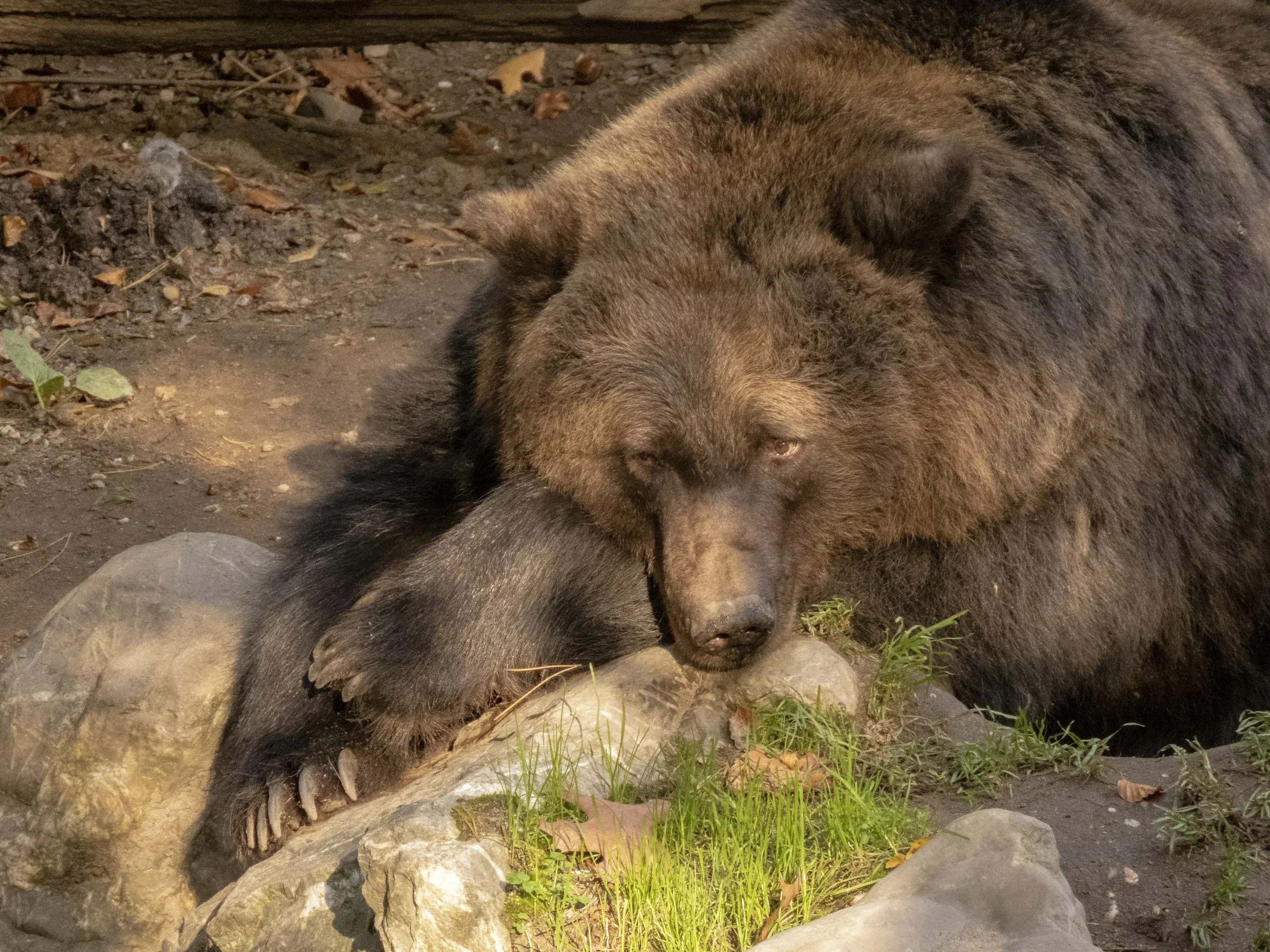
If there's a bear in the wild, one of the endangered ones, and the team needs to move it somewhere safer, they'll shoot it with a tranquilizer dart.
You'd think the bear just goes still and flops over, like a puppet with its strings cut.
It doesn't.
As the sedative kicks in, something wonderful and strange happens instead.
The bear's legs start moving. It shakes. Twitches.
Its whole body lets out, right there in real time, all that running energy that was still buzzing when the dart hit, the same energy that would have carried it through the forest if the moment had gone the way its body expected.
By the time the bear actually drifts off, its body has emptied out the leftover panic that never got to finish its job.
When the bear wakes up in its new home, hours later, it's not traumatized.
It's calm.
Because its body finished what it started. Tidy. Done. No leftovers. No little bundle of unspent energy tucked away in a drawer somewhere, waiting.
Why The Human Body Needs Somatic Work
Something is off in our wiring, or maybe it's exactly right in our wiring, depending on how you squint at it. But a person in that same moment, mid panic, doesn't just naturally shake and tremble it out the way the bear does.
We tend to override it, hold our breath, grit through it, be polite about our own nervous systems in a way no bear has ever bothered to be.
The fight that got cut short.
The escape that never had a route.
The freeze that locked in instead of letting go and running free.
It stays.
It stays in the chest, like a held breath nobody remembers holding.
It stays in the jaw, in that quiet, habitual clench.
It stays in the hips, tucked away in a place we rarely think to check.
It stays in a hundred tiny habits the body has been quietly running on autopilot for years, like a light left on in a room nobody uses anymore, humming away, costing something, for no one.
I keep coming back to the idea that trauma is less about the event itself and more about what we hold inside in the absence of an empathetic witness.
Sit with that for a second, let it be a little cozy chair you settle into rather than a hard fact you brace against. It's not the assault, the accident, the years of neglect, that decide how things turn out on their own.
It's whether the nervous system ever got a chance to finish what it started, with someone steady sitting next to it while it did.
Here's the part I find most useful, and honestly the part I find most tender.
The event itself might be years old, blurry, missing pieces, half forgotten the way old photographs go soft at the edges.
But the body wrote down something different than the mind did.
It wrote down a feeling, a held breath, a door that never got to close.
And that little unfinished story keeps quietly playing in the background, like a song stuck on repeat that nobody else can hear, waiting for an ending, until something in the room finally gives it the go ahead to arrive.
It's Not Weakness, It's Wiring
Your client who can't sleep through the night fifteen years after the assault is not weak.
Your client who jumps when their husband touches their shoulder is not broken.
Your client who feels wired and worn out at the same time is not lazy.
Their body is just doing what bodies do when something gets interrupted mid-response.
The energy is still in there, like a message that never got sent. It never went anywhere.
Bessel van der Kolk gets at this from another angle.
The feelings and sensations soaked up during a traumatic moment show up later not as memory but as disruptive physical reactions in the present.
That's the tricky part to explain to a client who thinks they should be over it by now.
They're not failing to move on.
Their body is still trying to finish an old story, and the only language it has for that is sensation.
Why Talking Isn't Where the Release Happens
The whole reason somatic work exists, in its deepest sense, is to give that unfinished business somewhere to go.
Not by talking about it.
Talking is downstream.
The somatic release doesn't come from finally putting it into words, it comes the way it comes for the bear.
Through the body.
Through trembling.
Through completion.
Through, sometimes, a small action the client never got to take ten years ago, one they finally get to take, slowly and gently, right there in your office.
This is something Stephen Porges shares when he pointed out that these actions can only happen when the conditions are just right.
He talks about something he calls neuroception, basically the body's built-in smoke detector, always quietly sniffing the air for safety or danger.
A client's body doesn't wait around for their thinking brain to weigh in on whether the room feels safe.
It decides on its own, faster than thought, just from your tone, your face, how steady your breathing sounds.
So before any of that old energy can finally move through, the body first has to decide, quietly and on its own terms, that this room, with you in it, isn't a threat.

Coaxing, Not Flooding in Trauma Work
This is also why going slow matters so much.
You're not flooding the system and hoping it all comes pouring out at once, the way the dart forces the bear's hand.
You're finding the tiniest edge of the sensation, the first little flicker of movement the body wants to make, and letting it move at its own pace, like coaxing a nervous cat out from under the couch.
Rush it, and you just recreate the overwhelm.
There's a gentle back and forth to somatic work too, a rocking between the hard feeling and a calmer one, until the body learns it can visit the edge of the old fear without falling in.
There's a reason this work asks so much of you as a clinician.
You're not just holding technique.
You're the calm little signal that tells your client's body it's finally safe enough to finish something it started years ago.
Levine's work on the empathetic witness isn't just a nice sentiment.
It's closer to a password.
Without it, nothing unlocks.
The old tremor stays locked away, right where it's been for years, because the body hasn't gotten proof yet that finishing is safe.
When somatic work goes well, your client gets to do something the bear could do for itself.
That's the whole project.
Warmly,
Esther